
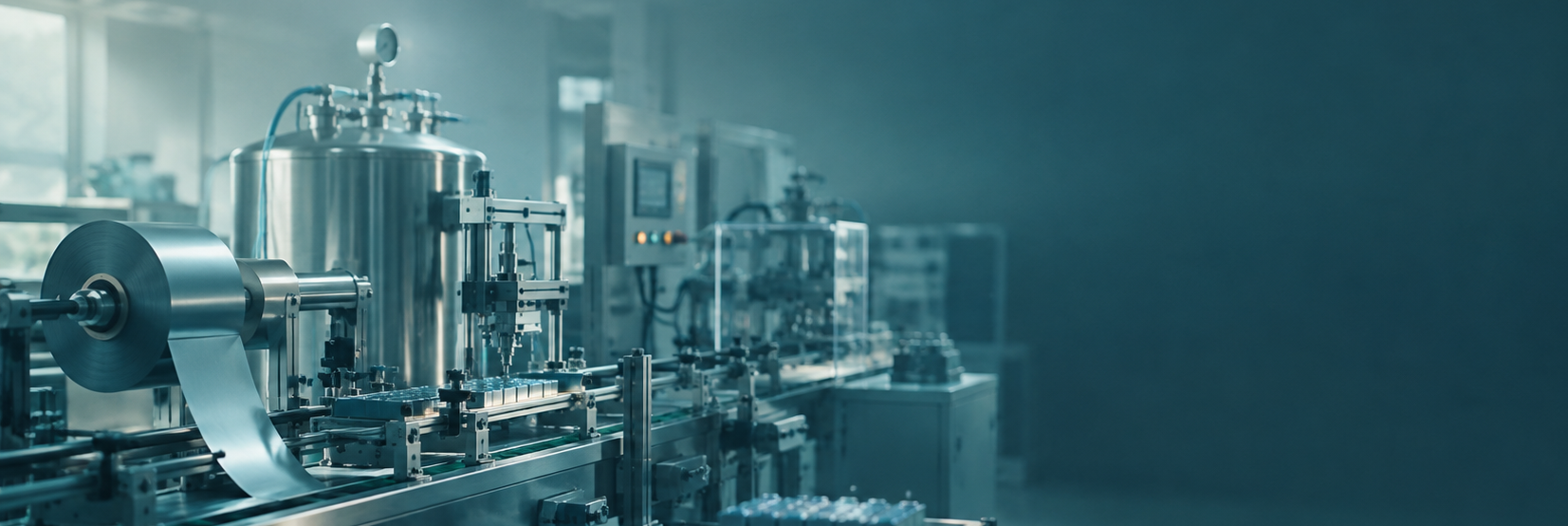
Our Pilot Line Project
Our pilot line project aims to demonstrate and scale up an innovative nickel-zinc (NiZn) battery technology through the development of a pilot manufacturing line in Europe.
The project addresses key challenges in energy storage by developing a safe, cost-effective and sustainable alternative to lithium-ion batteries, while contributing to decarbonisation and strengthening European industrial autonomy.

From pilot line to industrial production:
The pilot line currently under construction is funded by Bpifrance through the France 2030 programme and is expected to reach an operational capacity of 0.4 MWh by 2028.
Our ambition is to progressively expand the pilot line and transform it into a highly automated small-scale production facility, targeting a capacity of 20 MWh by 2030. This will enable the industrial validation of our technology under real-world operating conditions and provide a pathway towards commercial-scale production.
A simpler path to battery manufacturing
One of the key advantages of NiZn technology is the potential for a simpler and less resource-intensive manufacturing process compared with conventional lithium-ion batteries.
Zinc Electrode
NiZn cells use an aqueous alkaline electrolyte, rather than the moisture-sensitive organic electrolyte systems used in conventional Li-ion cells. This means that NiZn manufacturing does not require the same stringent ultra-dry-room conditions that are typically needed for Li-ion cell assembly. Conventional Li-ion production can also involve the use of organic solvents such as NMP, followed by energy-intensive drying and solvent-recovery processes.
By relying on water-based processing and a more manufacturing-tolerant chemistry, NiZn has the potential to reduce the complexity, energy requirements and capital investment associated with battery production. It can also reduce the need for solvent handling and recovery infrastructure, while avoiding some of the stringent environmental controls associated with conventional Li-ion electrode manufacturing. These characteristics open the possibility of more compact, simpler and cost-effective production facilities, particularly at pilot and distributed manufacturing scale.
This manufacturing simplicity is an important part of our ambition: to develop a battery technology that is not only sustainable in operation, but also simpler and more sustainable to manufacture.
Nickel Electrode
A sustainable battery technology:
NiZn technology builds on established alkaline battery principles, combined with innovations in electrode and electrolyte formulations, cell design and manufacturing processes.
The technology uses abundant and recyclable materials such as nickel and zinc, avoids reliance on critical lithium resources, and uses water-based processing without toxic organic solvents. These characteristics can help reduce environmental impact, simplify manufacturing, and improve supply chain resilience.
Compared with conventional Li-ion manufacturing, where moisture control, solvent management and electrode drying can require significant energy and complex infrastructure, the aqueous nature of NiZn chemistry provides an opportunity for a lower-complexity manufacturing environment.
Supporting Europe's energy transition:
NiZn battery manufacturing has the potential to significantly reduce greenhouse gas emissions through lower-impact production and by enabling sustainable energy storage applications.
By leveraging European supply chains and developing local know-how and intellectual property, our pilot line will contribute to European industrial competitiveness, skilled job creation and strategic autonomy.
The pilot line represents a key step towards the commercial deployment of next-generation sustainable battery technology, supporting Europe's transition to a more resilient and climate-neutral energy system.