
ZABSES Project Concludes with Significant Advances in Rechargeable Zinc–Air Batteries
ZABSES was a French–German collaborative project running from 2022 to 2026, jointly funded by the French National Research Agency (ANR) and the German Federal Ministry of Education and Research (BMBF). The consortium brought together partners from both sides of the Rhine, SUNERGY, ZSW, CY Cergy Paris University and DLR, with VARTA contributing as an advisory board member.
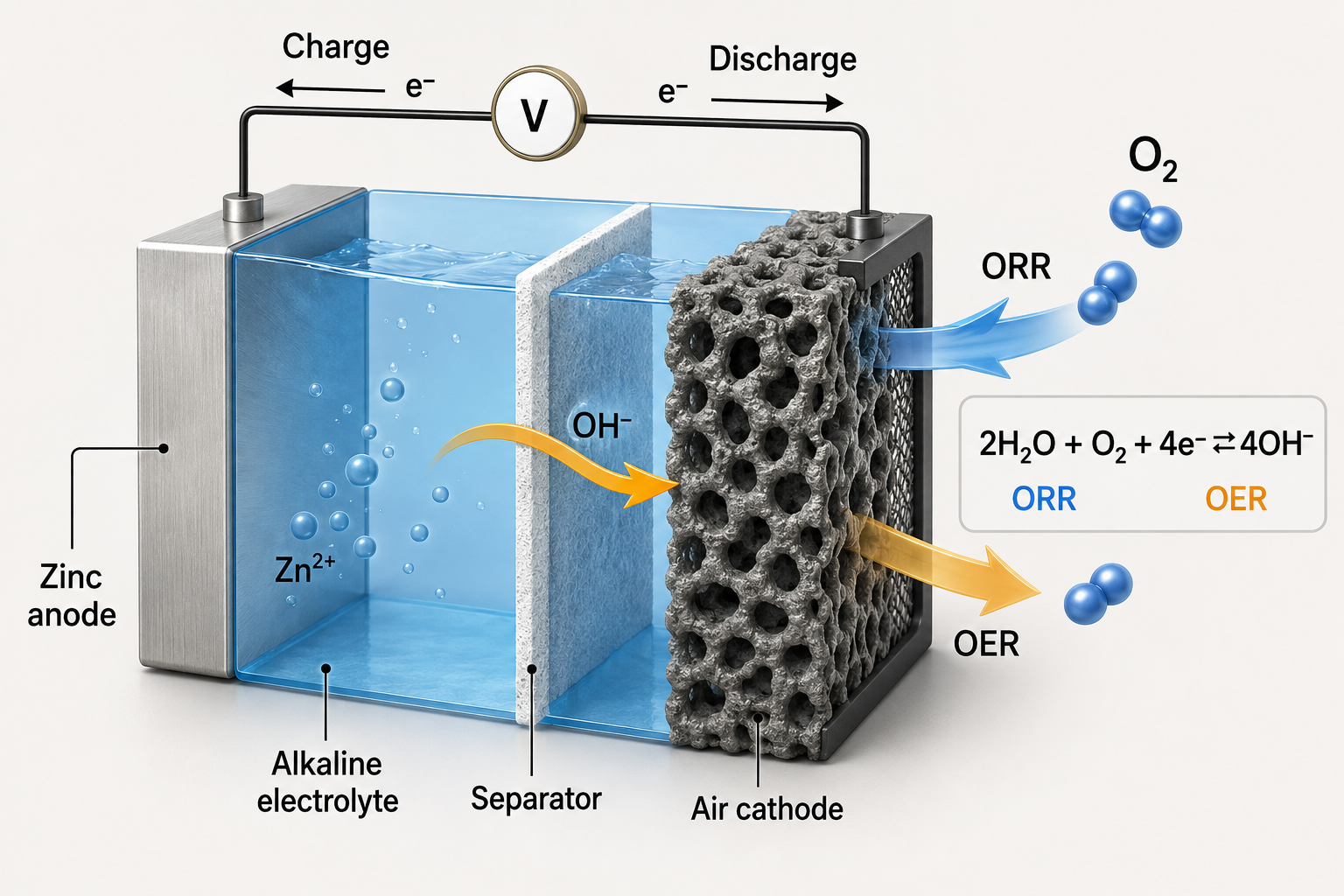
The ZABSES project has concluded after advancing the development of rechargeable alkaline zinc–air (Zn-air) batteries for large-scale stationary energy storage. Based on inexpensive, abundant and non-critical materials, Zn-air batteries offer high theoretical energy density and the potential for safe, aqueous operation. ZABSES aimed to establish the scientific and technological basis of this technology up to prototype/demonstrator level and progress it from laboratory proof-of-concept towards TRL4.
The project followed an integrated approach combining materials and component development, demonstrator testing and electrochemical modelling. Work focused on optimising the zinc anode and electrolyte, developing bifunctional air cathodes for oxygen reduction and evolution, integrating polymer membranes to address carbonation and flooding, building rechargeable cells and demonstrators, and establishing a full-cell modelling framework. Close interaction between these activities enabled component-level results to be transferred to larger cells, while modelling helped interpret experimental results and identify performance limitations.
The project’s progress was supported by close and constructive collaboration between the partners, whose complementary expertise covered zinc electrodes and electrolytes, polymer membranes, bifunctional air cathodes, prototype development and modelling. Regular consortium meetings and focused technical exchanges enabled the partners to coordinate activities, share results and adapt priorities throughout the project. In particular, close cooperation between SUNERGY and ZSW supported the transfer of component developments into prototype and demonstrator cells, while CYU-LPPI and ZSW collaborated on membrane integration and testing, and DLR worked closely with the experimental partners on modelling and data interpretation. This interdisciplinary collaboration was essential to maintaining a coherent development path from materials research to demonstrator testing.
Several important results were achieved. Suitable zinc-electrode formulations and electrolyte conditions for rechargeable operation were identified. A durable bifunctional gas-diffusion air cathode and robust testing methodology were developed, with the best configurations sustaining approximately 150 days of cycling under the final testing conditions. Promising anion-conducting polymer membranes were also developed and tested. Although their stabilising effect remained partial under cell-relevant conditions, the work clarified their potential and limitations in addressing air-electrode carbonation and flooding.
The project successfully progressed from laboratory cells to rechargeable Zn-air prototypes and demonstrators, demonstrating the transfer of the bifunctional air-cathode concept to larger cells. Testing of different cell designs, electrolyte conditions and operating parameters provided valuable insight into the factors governing full-cell performance, including flooding and carbonation, gas and electrolyte management, cathode overpotential, separator configuration and zinc-side behaviour.
In parallel, ZABSES established a thermodynamically consistent full-cell model, including a dedicated model for membranes in multi-ionic aqueous environments. The modelling supported interpretation of experimental results and provides a basis for future model-based optimisation of Zn-air systems.
Although not all initial performance targets were reached within the project duration, ZABSES significantly advanced the technological maturity and understanding of rechargeable Zn-air batteries. The project delivered a durable bifunctional air-cathode platform, validated zinc and electrolyte concepts, promising membrane approaches, a demonstrator architecture and a robust modelling framework, providing a strong foundation for further optimisation and future development of this energy-storage technology.